
Endpoints
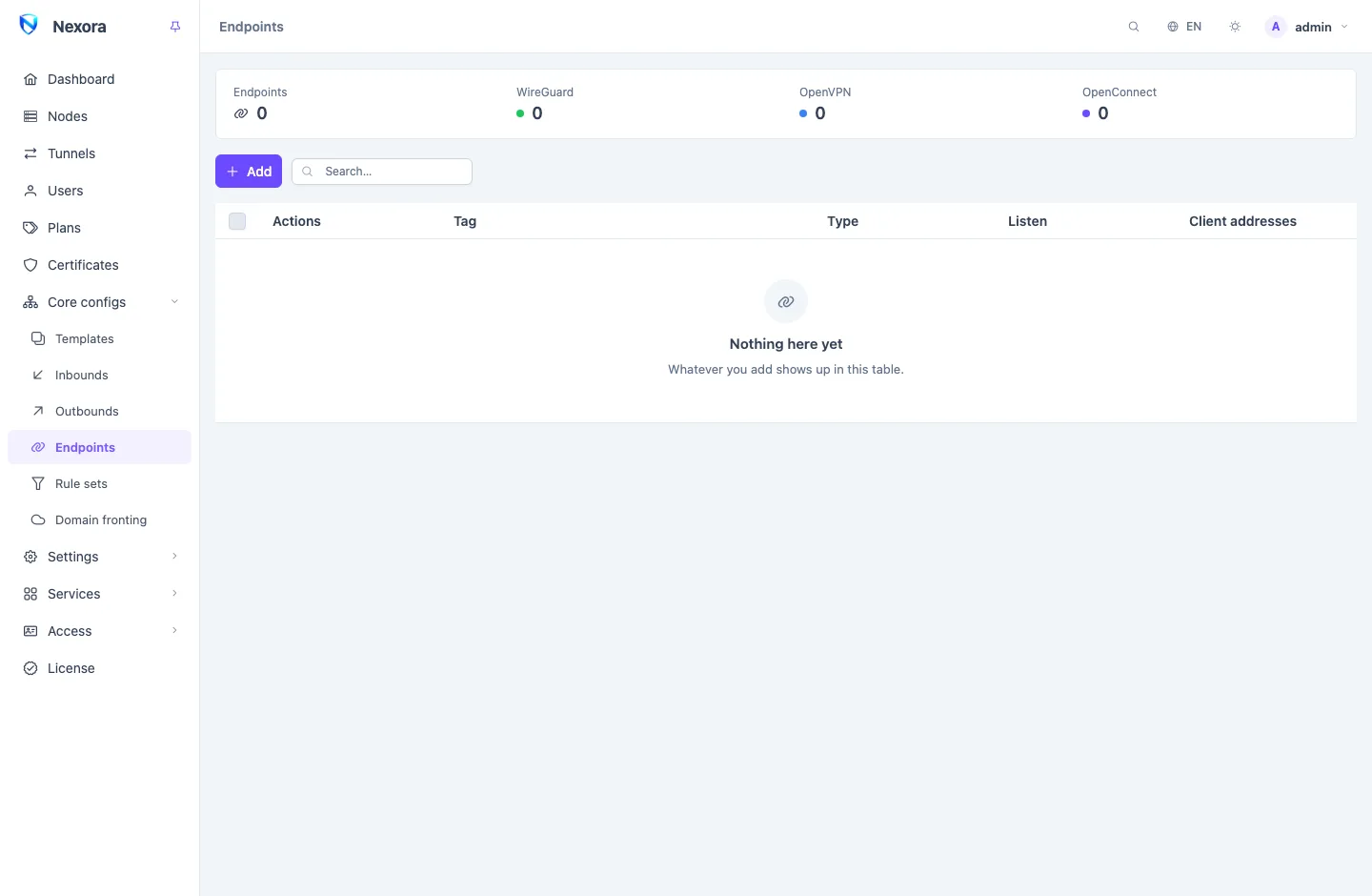
An Endpoint is an interface that is a way in and a way out at once. WireGuard, OpenVPN and OpenConnect are endpoints: users connect to them with the dedicated app for that protocol, and the panel gives each user a config file to import. Endpoints live under Core configs → Endpoints and reach nodes through Templates, like inbounds.
Serving users or connecting out
An endpoint does one of two jobs, and the listen port decides which:
- With a listen port, it serves your users. Each user of its template gets an account on it.
- Without one, it is a client: the node connects out to another network, and routing can send traffic through it like an Outbound. The list marks such an endpoint client only.
| Type | Serves users | Connects out |
|---|---|---|
wireguard | yes, with a listen port | yes, without one |
openvpn-server | yes | |
openconnect-server | yes | |
openvpn-client | yes | |
openconnect | yes | |
tailscale | joins a Tailscale network |
The Client addresses column shows the address pool users draw their tunnel address from.
WireGuard
A WireGuard endpoint that serves users needs an Address (CIDR list), the pool user addresses come from, and a Listen port (set to serve panel users). The server's Private key is made for you.
You never handle user keys. For every user who reaches the endpoint, the panel:
- makes a key pair of the user's own;
- gives the user a fixed address from the pool, worked out from the account's id, so it never changes and never collides with another user's;
- adds the user as a peer on every node of the template.
Because the address follows the account id, the pool must reach as far as your highest account id, not just your number of users. An account whose id lies past the end of the pool gets no peer on that endpoint. With 10.8.0.1/24, account ids up to about 250 fit; for a larger or older panel use a bigger pool such as 10.8.0.1/16.
Adding or removing a user rebuilds the WireGuard endpoint on its nodes, and connected WireGuard clients come back within about twenty seconds.
See WireGuard for the options and for client apps.
OpenVPN and OpenConnect
An openvpn-server or openconnect-server endpoint authenticates each user by their account name and password. Both serve TLS, so they take a certificate like a TLS inbound: under TLS certificate, pick the node's certificate, a stored certificate from Certificates, or the endpoint's own.
On an OpenVPN server, Address (CIDR list) is the pool user addresses come from; Push: redirect gateway and Push: DNS servers decide whether clients send all traffic through it and which resolvers they use. On OpenConnect the pool is Client IP pool (CIDR), with Pushed DNS servers and Split-include routes.
An OpenVPN or OpenConnect server with no user at all is not started: the panel leaves it out of what it sends until a user belongs to its template.
See OpenVPN and OpenConnect for the options and for client apps.
Tailscale
A tailscale endpoint joins the node to a Tailscale network with an Auth key. It can Advertise routes (CIDR list) or Advertise as exit node, and can use another device as its Exit node. It does not serve panel users; use it to reach a private network from the node, or to send traffic out through one.
App config files
WireGuard, OpenVPN and OpenConnect users import a file rather than a link. The panel builds one per user, per endpoint and node:
| Endpoint | File | What it carries |
|---|---|---|
| WireGuard | .conf | The user's own private key and address, and the server's public key and address |
| OpenVPN | .ovpn | The server's certificate and the user's name and password, inline |
| OpenConnect | .txt | The server address and the user's name and password |
Users find these files in two places:
- On their subscription page, each with a QR code, the text, and a download button.
- You can give them out from the user's row: QR / Links opens Client apps, with Save file and a QR code for each. A file too large for a QR code is offered as text and download only.
A config file names one address. It uses the node's first link address, the primary, so reordering a node's link addresses changes the files users download afterwards. Files users already saved keep the old address; send them a new one. See Nodes.
Per-node endpoints
A node can carry endpoints of its own on top of its template, under Per-node endpoints in its Config panel. A WireGuard client to an upstream network that only one server should use is a typical case.
Editing and deleting
Edits reach every node that carries the endpoint. Duplicate copies one under a new tag and listen port. The panel refuses to delete an endpoint that a routing rule or a template's final outbound still names, and lists those references.
Related
- WireGuard, OpenVPN and OpenConnect: protocol details.
- Templates: how endpoints reach nodes and users.
- Certificates: certificates for OpenVPN and OpenConnect.
- Subscriptions and the subscription page: the subscription page that offers the files.