
Protocols
This section is about choosing what your users connect with. Each protocol is an Inbound you create once in the shared pool and put on a Template; the nodes on that template serve it, and every user of the template gets an entry for it in their Subscription. How to create one is on Inbounds; the pages here explain each protocol's fields and limits.
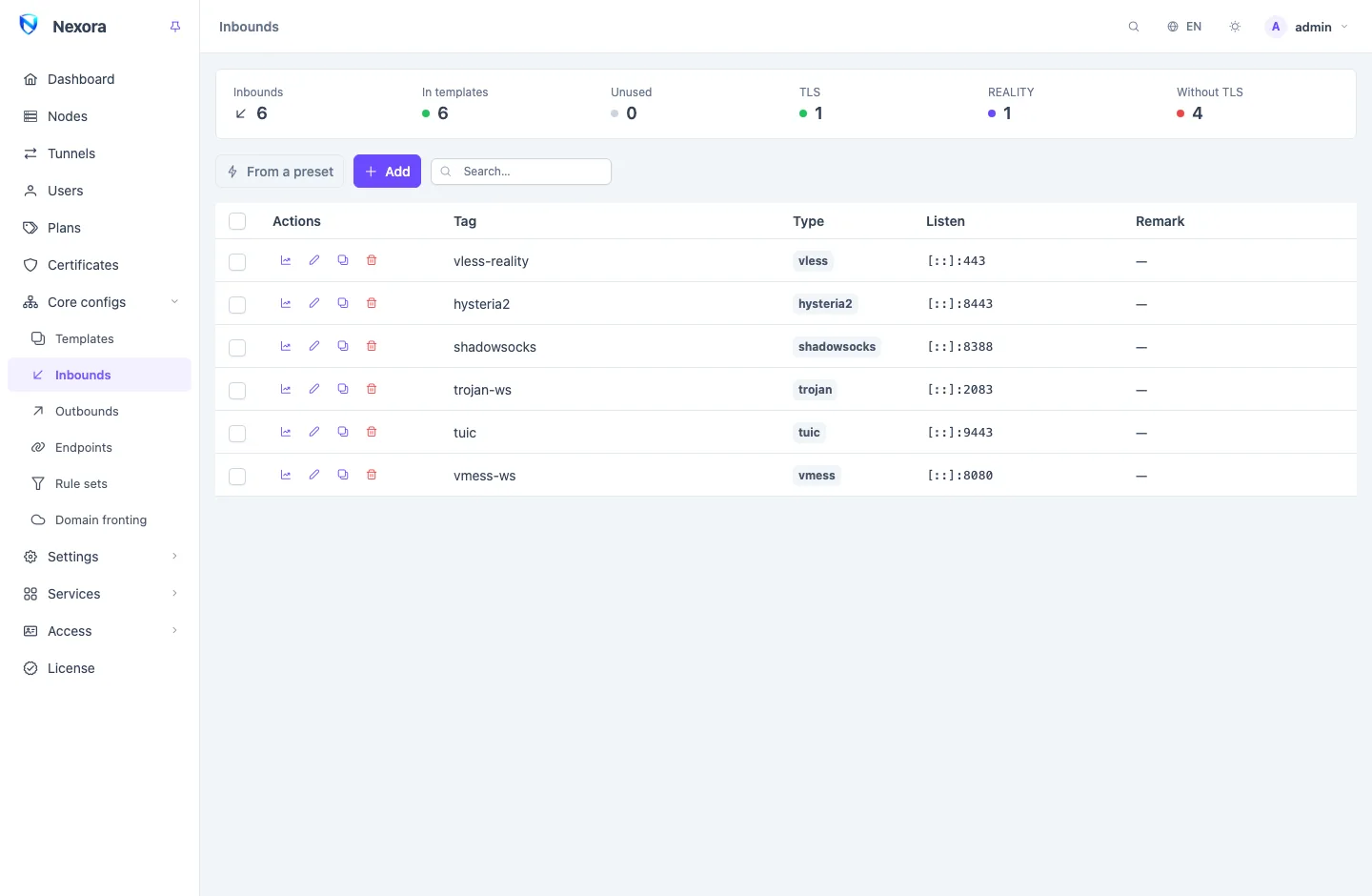
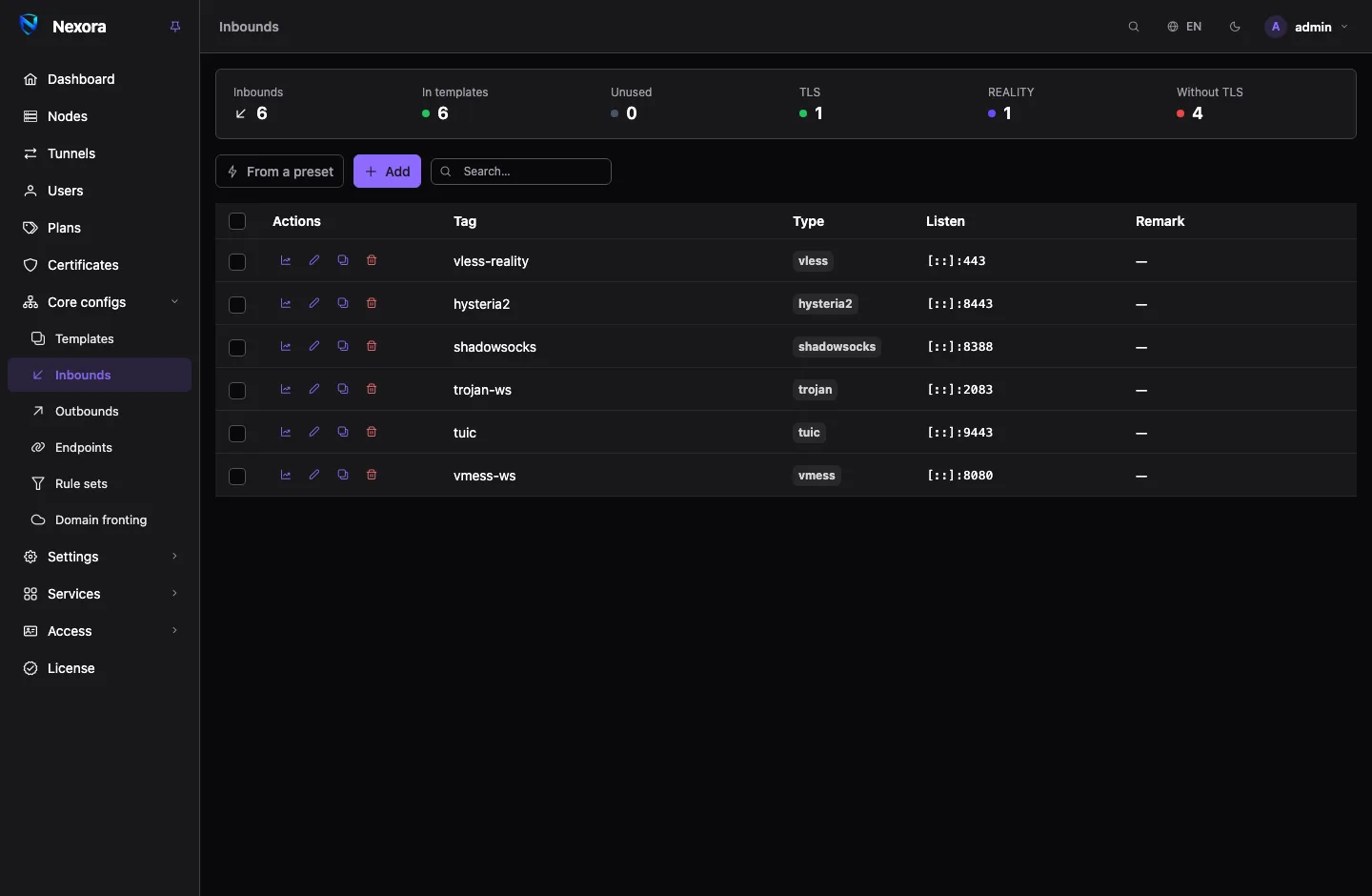
Every inbound at a glance
Runs over is what the node listens on, which is what your firewall has to let in. TLS lists the modes the form offers: a certificate (the node's own, one from the panel's store, or your own PEM pair), REALITY, or none. Behind a CDN says whether a domain front can carry it.
| Protocol | Runs over | TLS | Behind a CDN | Page |
|---|---|---|---|---|
| VLESS | TCP (UDP with the quic or mkcp transport) | TLS, REALITY, none | yes, with an HTTP-shaped transport and no REALITY | VLESS with REALITY |
| VMess | as VLESS | TLS, REALITY, none | as VLESS | VMess |
| Trojan | as VLESS | TLS, REALITY, none | as VLESS | Trojan |
| Shadowsocks | TCP and UDP | none (its own encryption) | no | Shadowsocks |
| Hysteria2, Hysteria (v1) | UDP (QUIC) | TLS, required | no | Hysteria2 and port hopping |
| TUIC | UDP (QUIC) | TLS, required | no | TUIC |
| NaiveProxy | TCP (HTTP/2), optionally UDP (HTTP/3) | TLS, required | no | NaiveProxy |
| AnyTLS | TCP | TLS or REALITY, required | no | More protocols |
| ShadowTLS | TCP | borrowed from a real site | no | More protocols |
| Mieru | TCP or UDP | none (its own encryption) | no | More protocols |
| Snell | TCP | none (its own encryption) | no | More protocols |
| MTProxy | TCP | none (its own encryption) | no | More protocols |
| SSH | TCP | SSH's own | no | More protocols |
| TrustTunnel | TCP or UDP | TLS, required | no | More protocols |
| Sudoku | TCP | none (its own encryption) | no | More protocols |
| SOCKS, mixed | TCP | none | no | More protocols |
| HTTP | TCP | TLS, REALITY, none | no | More protocols |
| Ingress | TCP | TLS or none | through its children | One port for many inbounds |
| WireGuard (endpoint) | UDP | WireGuard's own | no | WireGuard |
| OpenVPN (endpoint) | UDP or TCP | TLS (certificate) | no | OpenVPN and OpenConnect |
| OpenConnect (endpoint) | TCP and UDP | TLS (certificate) | no | OpenVPN and OpenConnect |
VLESS, VMess and Trojan take a transport: tcp (none), ws, grpc, http (HTTP/2), httpupgrade, quic, xhttp or mkcp. No other protocol has a transport. A CDN can carry the HTTP-shaped ones: ws, grpc, http, httpupgrade and xhttp.
WireGuard, OpenVPN and OpenConnect are endpoints, made on Endpoints. They reach users the same way inbounds do. The local types the form also lists (tun, redirect, tproxy, direct) are not for customers; see More protocols.
Which apps read what
A subscription answers in the format the app asks for. Four formats matter:
- Share links (
vless://,trojan://,hysteria2://…), read by almost every app, including the Xray-based apps (v2rayNG, v2rayN, Streisand, Happ). - Clash, read by Clash Meta and other mihomo apps.
- sing-box, read by sing-box apps (SFA, SFI, Karing, NekoBox).
- Xray JSON, read by Xray-based apps.
An entry an app cannot use is left out of that app's file, so the same user can see a different list in two apps.
| Protocol | Share link | Clash | sing-box | Xray JSON |
|---|---|---|---|---|
| VLESS | yes | yes | yes, except with VLESS Encryption | yes, except without TLS, REALITY or VLESS Encryption |
| VMess, Trojan | yes | yes | yes | yes |
| Shadowsocks | yes | yes | yes | yes |
| Hysteria2 | yes | yes | yes | yes |
| Hysteria, TUIC, AnyTLS | yes | yes | yes | no |
| NaiveProxy | yes | no | yes | no |
| SOCKS, mixed | yes | yes | yes | yes |
| HTTP | no | yes | yes | yes |
| SSH | no | yes | yes | no |
| Mieru | no | yes | no | no |
| Snell | no | no | yes | no |
| ShadowTLS, MTProxy, TrustTunnel, Sudoku | no | no | no | no |
| WireGuard | .conf file | yes | yes | yes |
| OpenVPN | .ovpn file | no | yes | no |
| OpenConnect | server and sign-in details | no | yes | no |
For VLESS, VMess and Trojan the transport decides as well:
| Transport | Clash | sing-box | Xray JSON | Behind a CDN |
|---|---|---|---|---|
tcp (none) | yes | yes | yes | no |
ws (WebSocket) | yes | yes | yes | yes |
grpc | yes | yes | yes | yes |
http (HTTP/2) | yes | yes | no | yes |
httpupgrade | yes | yes | yes | yes |
quic | no | yes | no | no |
xhttp | no | no | yes | yes |
mkcp | no | no | yes | no |
Share links carry every transport; whether a given app can dial it is the app's business.
Tell users to turn Mux off
Xray-based apps have a Mux switch. Turned on, the connection fails with nothing in the app to explain it. The subscription page warns about it; repeat it in your own setup instructions. See Subscriptions and the subscription page.
How to choose
- Start with VLESS + REALITY. It needs no domain and no certificate, works in nearly every app, and is the first preset on Inbounds → From a preset.
- Add a WebSocket, gRPC or XHTTP inbound with TLS when you want to put a CDN in front. REALITY cannot be fronted. See Domain fronting.
- Add Hysteria2 for users on lossy mobile or long-distance links, where a UDP protocol holds up better than TCP. It needs UDP to reach the node, and port hopping helps where single UDP ports are blocked.
- Offer two or three shapes. Different networks block different things. A subscription with a TCP protocol, a CDN-fronted one and a UDP one gives a user something that works when one of them stops.
- Use an ingress when you have only port 443 to spare and want several TCP inbounds on it.
- Use WireGuard or OpenVPN / OpenConnect for users who need a standard VPN app, a router, or a work laptop that can only run one of those.
Every protocol carries the same accounting, quotas, speed and address limits per user; nothing about the choice changes how you sell an account.
Related
- Inbounds — creating, editing and placing inbounds
- Endpoints — WireGuard, OpenVPN and OpenConnect
- Certificates — the certificates TLS inbounds use
- From a template to a link — how a subscription is assembled