
API tokens
An API token lets a program use the panel's API: your billing script, a bot, a monitoring job. Each token acts as one admin account and never reaches further than that account. This page is under Access → API tokens and is open to main admins.
How a token is limited
A token is narrowed three ways, and each is checked again on every request:
- Acts as: the admin it is bound to. The token sees what that admin sees. A token bound to a reseller sees only that reseller's users and spends its allowance. Deleting the admin deletes the token.
- Role: the tier the token works on, never above its admin's. Demoting the admin demotes the token with it.
- Scopes: the routes the token may reach inside that role, intersected with the permissions of its admin's role. Narrowing the admin's role narrows every token bound to it at once, with nothing to issue again.
A change to any of these takes effect on the token's next request.
Creating a token
- Add.
- Description: what the token is for, so you recognise it later.
- Acts as: the admin whose access the token gets.
- Role: the tier, up to that admin's.
- Scopes: leave No restriction for every route the role reaches (including scopes a later release adds), or untick it and choose.
- Addon id: leave it empty for an ordinary integration. It is for a token that belongs to an addon you add by hand (see Addons page).
- Requests per minute:
0uses the panel default of 120. - Validity (days):
0means it never expires. - Save.
The panel then shows the token once. Copy it before you close the dialog: only a hash is stored, so it cannot be shown again. A lost token is deleted and replaced.
TIP
If two-factor authentication is on for your account, creating or deleting a token asks for your code again when your last one is more than ten minutes old.
Send the token on every request:
curl -H "Authorization: Bearer $NEXORA_TOKEN" \
  https://panel.example.com/your-base-path/api/v1/me
/api/v1/me answers which admin the token acts as and which scopes it holds.
Scopes
A :write scope includes the matching :read. The panel's form shows the names in the second column; the API and the API reference use the first.
| Scope | Shown as |
|---|---|
users:read | See users |
users:write | Create and edit users |
nodes:read | See nodes |
nodes:write | Configure nodes |
tunnels:read | See tunnels |
tunnels:write | Configure tunnels |
nodes:install | Install nodes over SSH |
templates:read | See templates |
templates:write | Edit templates |
pool:read | See inbounds, outbounds and rule sets |
pool:write | Edit inbounds, outbounds and rule sets |
certificates:read | See certificates |
certificates:write | Issue and edit certificates |
settings:read | See settings |
settings:write | Change settings |
stats:read | Traffic, reports and health |
tools:write | Key generators |
admins:write | Manage operators and roles |
tokens:write | Manage API tokens |
license:write | Manage the licence |
backup:read | Download backups |
backup:write | Take and delete backups |
backup:deliver | Send files to the backup chat |
security:read | See the ban list |
security:write | Change the ban list |
webhooks:read | See event subscribers |
webhooks:write | Change event subscribers |
services:read | See panel services |
services:write | Configure and test panel services |
Grant the least a program needs. Three scopes are the panel's own administration: admins:write, tokens:write and license:write. Leave them off unless the program truly needs them; a token without them cannot create accounts or mint further tokens, so a leaked one cannot make itself permanent. backup:read reads out the whole database with every credential in it, and nodes:install logs in to your servers as root, so both are worth the same care.
A few routes are closed to every token whatever its scopes: changing the caller's own password, its dashboard layout, restarting the panel, the panel update, and restoring a backup. A few are open to every token: /api/v1/me, the scope list and the event catalogue.
Rate limit
Each token has a budget of requests per minute (120 unless you set another). Every answer carries X-RateLimit-Limit, X-RateLimit-Remaining and X-RateLimit-Reset. A request over the budget gets 429 with Retry-After; wait that many seconds before the next one.
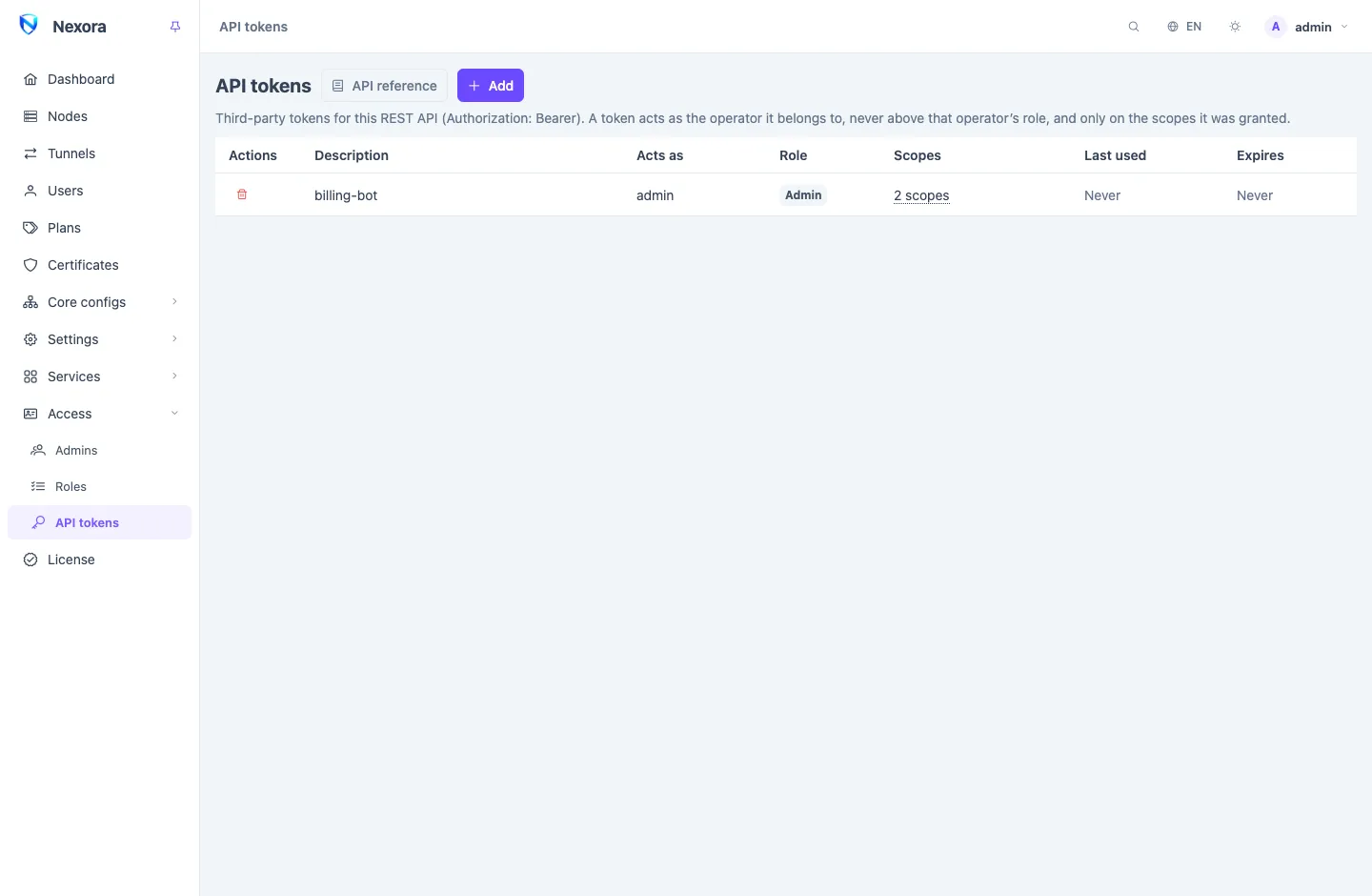
The list
| Column | |
|---|---|
| Description | with an Addon: name tag when an addon holds the token |
| Acts as | the admin it is bound to |
| Role | its tier |
| Scopes | No restriction, or the number of scopes (point at it for the list) |
| Last used | when it was last used; point at it for the address it came from |
| Expires | its expiry date, or never |
A token is not edited after it is made: delete it and create another. A token that an addon holds cannot be deleted here; it is changed or removed with the addon on the Addons page page.
The API
API reference at the top of this page opens the reference for this install, with its own addresses filled in: every route, the scope it needs, listing and paging, retries with Idempotency-Key, and the status codes. The same material is on API reference.
Build against the /api/v1 prefix. It is the stable public contract. The unversioned /api prefix is the panel interface's own and may change with it.
Related
- Admins and Roles: what the token's admin may do.
- Webhooks and events: receive events instead of polling.
- API reference: the API reference.
- Audit log: what a token changed.